

What is diabetes?
Your body turns food into glucose for energy. A hormone called insulin, made by the pancreas, moves glucose from the blood into your cells. In diabetes, the body either does not make enough insulin or cannot use insulin well. Glucose then builds up in the blood.
Diabetes is very common. The ICMR-INDIAB study (2023) estimated that about 101 million people in India have diabetes, and about 136 million have prediabetes. Diabetes is also common in the Gulf countries and is rising in Africa (WHO).
Types of diabetes
Type 1 diabetes
The body's immune system destroys the cells that make insulin. It often starts in childhood or young adulthood, but can start at any age. People with type 1 diabetes need insulin every day for life. It is not caused by diet or lifestyle.
Type 2 diabetes
The most common type (about 9 in 10 people with diabetes). The body does not use insulin well and, over time, makes less of it. Risk is higher with family history, extra weight around the waist, low physical activity and older age. People of South Asian, Middle Eastern and African origin can develop type 2 diabetes at a younger age and a lower body weight.
Prediabetes
Blood sugar is higher than normal but not yet in the diabetes range. Many people with prediabetes can delay or prevent type 2 diabetes with weight loss and regular activity.
Gestational diabetes
Diabetes that starts during pregnancy. It usually goes away after birth, but it raises the mother's risk of type 2 diabetes later.
Other types
Less common types include diabetes caused by single-gene changes (MODY), by diseases of the pancreas, or by some medicines such as steroids.
Symptoms
Many people with type 2 diabetes have no symptoms for years. When symptoms appear, they may include:
- Feeling very thirsty and passing urine often, including at night
- Tiredness
- Weight loss without trying (more common in type 1)
- Blurred vision
- Cuts and sores that are slow to get better
- Repeated infections, such as skin, gum or urine infections
- Tingling or numbness in the feet
Go to an emergency department immediately if someone with diabetes has vomiting, stomach pain, fast breathing, confusion or drowsiness. These can be signs of diabetic ketoacidosis, which is life-threatening.
How diabetes is diagnosed
Diabetes is diagnosed with blood tests. The ADA and WHO use these values:
Unless symptoms are clear, the test is usually repeated to confirm the result. Note: Gulf countries often report glucose in mmol/L; India usually uses mg/dL.
Diabetes care at StemRx
[confirm every step and the doctor's specialty]
Step 1. Report review. Send your recent tests and medicine list. A doctor tells you which tests you need and how long your visit may take.
Step 2. Full diabetes check. In one or two days we can do:
- A consultation with a [diabetologist / physician — confirm]
- Blood tests: HbA1c, fasting glucose, cholesterol (lipid profile), kidney function (creatinine and eGFR) and urine albumin (UACR), liver tests and others as needed
- A diabetic foot examination: feeling (sensation), pulses and skin checks
- An eye screening (dilated eye exam or retinal photograph) [confirm whether on site or referred]
- Blood pressure, weight and waist measurement
- An ECG and heart tests if needed (our cardiology team and cath lab are on site)
Step 3. Your personal plan. You receive a written plan with your targets (for example HbA1c), your medicines, a meal plan, an activity plan and a schedule for checks at home.
Step 4. Learning to manage diabetes. A diabetes educator or dietitian [confirm] teaches you how to check your blood sugar, recognise and treat low sugar, read food labels and care for your feet.
Step 5. Follow-up. We follow up by video call and share your plan with your doctor at home [confirm].
Food and physical activity
Food and activity are the base of diabetes care for everyone, including people who take medicines or insulin.
Healthy eating
- Fill half your plate with vegetables and salad, a quarter with protein (dal, beans, fish, chicken, eggs, paneer, yoghurt) and a quarter with whole grains (brown rice, whole-wheat roti, millets, oats).
- Choose whole grains over white rice, white bread, maida and refined flour.
- Limit sweets, sugary drinks, fruit juice and dates in large amounts. Whole fruit in small portions is fine for most people.
- Cut down on fried foods and foods made with a lot of ghee or oil.
- Our dietitian [confirm] adapts your plan to your usual food, whether Indian, Arabic or African, so that it is realistic to follow at home.
Physical activity
- Aim for at least 150 minutes of moderate activity each week, such as brisk walking, spread over at least 3 days.
- Add muscle-strengthening exercises 2–3 times a week.
- Break up long periods of sitting.
- If you have foot problems, eye problems or heart disease, ask your doctor which activities are safe.
Weight
For people with type 2 diabetes who are overweight, losing even 5–10% of body weight can improve blood sugar, blood pressure and cholesterol. Some people who lose a lot of weight can keep their blood sugar in the normal range without medicines for a time. This needs medical supervision and continued checks, because blood sugar often rises again. StemRx does not offer "diabetes reversal" programmes.
Medicines and insulin
Your doctor chooses medicines based on your type of diabetes, your blood sugar, your weight, your kidney and heart health, and cost. Common options include:
- Metformin: often the first medicine for type 2 diabetes.
- SGLT2 inhibitors (for example dapagliflozin, empagliflozin): lower blood sugar and also protect the heart and kidneys in some people.
- GLP-1 receptor agonists (for example semaglutide, liraglutide, dulaglutide): injections or tablets that lower blood sugar and help with weight loss.
- DPP-4 inhibitors (for example sitagliptin, vildagliptin, teneligliptin).
- Sulfonylureas (for example gliclazide, glimepiride): effective and low-cost, but can cause low blood sugar.
- Insulin: essential for type 1 diabetes, and needed by many people with type 2 diabetes over time.
Never stop or change your diabetes medicines on your own. Always speak to your doctor first.
Monitoring your diabetes
Diabetic foot care
High blood sugar can damage the nerves and blood vessels in the feet. A small cut or blister may not be felt and can turn into an ulcer. Foot ulcers are a common reason for hospital stays and amputations in people with diabetes.
Look after your feet every day
- Check both feet every day, including between the toes and the soles. Use a mirror or ask someone to help.
- Wash and dry your feet carefully, especially between the toes.
- Do not walk barefoot, indoors or outdoors, including at the mosque, temple or beach.
- Wear well-fitting shoes and check inside them before you put them on.
- Do not use hot water bottles or heaters on your feet; you may not feel a burn.
- See a doctor the same day if you notice a wound, redness, swelling, a change in colour or a bad smell.
Diabetic foot ulcer care at StemRx [confirm services]
- Wound assessment, including checks for infection and blood flow
- Removing dead tissue (debridement) and regular dressings
- Taking pressure off the ulcer with special footwear or casts (offloading)
- Antibiotics if there is infection
- Referral to a vascular surgeon if blood flow is poor [confirm]
- Blood sugar control during treatment
Hyperbaric oxygen therapy (HBOT) for some foot ulcers
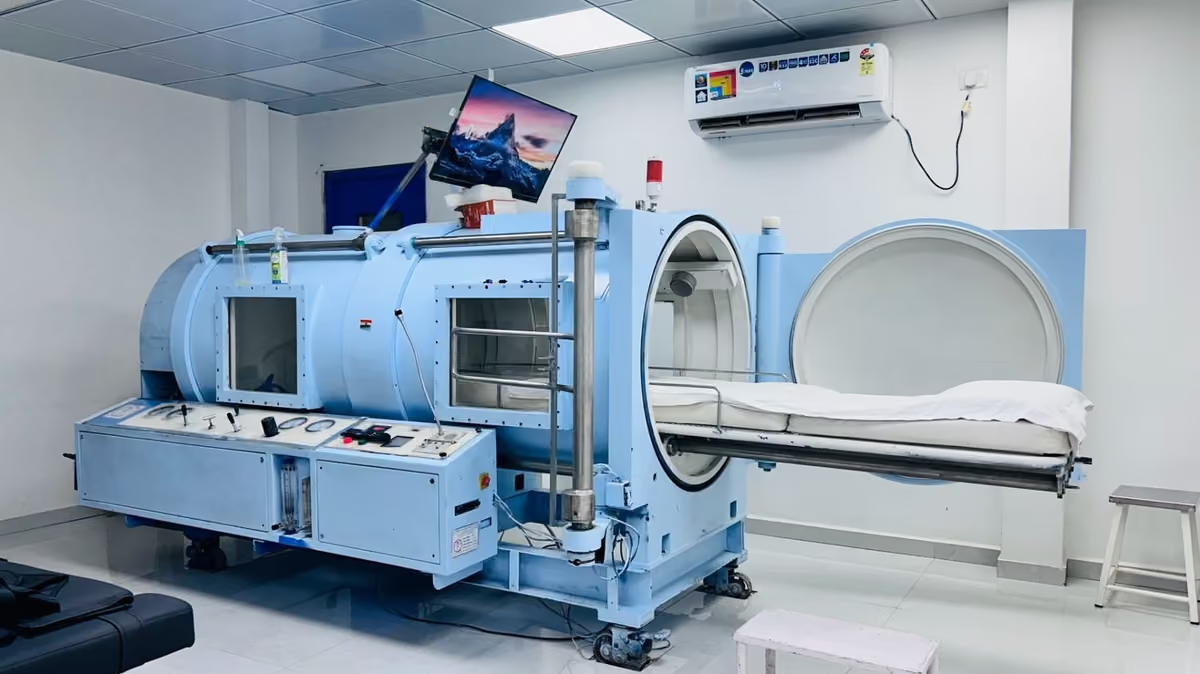
In HBOT, you breathe pure oxygen in a pressurised chamber. International guidance (IWGDF 2023) suggests that HBOT may be considered as an extra treatment for some diabetic foot ulcers that have not got better despite good standard care, especially when blood flow to the foot is reduced. It is not a replacement for standard wound care, and it is not suitable for everyone. A course is usually 30–40 sessions of about 90–120 minutes, 5 days a week [confirm StemRx protocol]. Your doctor will check whether it is right for you. See HBOT for diabetic foot ulcers.
Eye and kidney screening
Eyes. Diabetes can damage the back of the eye (diabetic retinopathy) without symptoms until late. Regular eye screening finds changes early, when treatment such as laser or eye injections can protect sight. [confirm: on-site eye screening, or referral to a named eye hospital]
Kidneys. Diabetes can slowly damage the kidneys. A yearly urine albumin test and an eGFR blood test find early damage. Good control of blood sugar and blood pressure, and some medicines, can slow it down.
Fasting during Ramadan
Many of our patients from the Gulf and Africa fast during Ramadan. Fasting with diabetes is possible for some people but risky for others, especially people on insulin or sulfonylureas, people with type 1 diabetes, pregnant women and people with kidney disease. Speak to your doctor 6–8 weeks before Ramadan. Your doctor can change the timing or dose of your medicines and tell you when to break the fast for safety.
What StemRx does not offer for diabetes
- StemRx does not offer stem cell, "islet regeneration" or any cell-based treatment for diabetes. In India these are not approved and may be given only inside registered clinical trials.
- StemRx does not offer "diabetes reversal" programmes or any treatment that claims to remove diabetes permanently.
- We do not ask anyone to stop insulin. People with type 1 diabetes need insulin for life.
Treatment targets
Targets are set for each person, but for most adults with diabetes they are:
| Measure | Usual target |
|---|---|
| HbA1c (average blood sugar over 3 months) | below 7% (53 mmol/mol); higher for older or frail people, lower for some younger people |
| Fasting / before-meal glucose | about 80–130 mg/dL |
| Blood pressure | below 130/80 mmHg for most people |
| LDL cholesterol | below 100 mg/dL; below 70 mg/dL if you have heart disease or high risk |
Diabetes treatment protocol: the steps
Guidelines from the American Diabetes Association (ADA) and the Indian Council of Medical Research (ICMR) follow similar steps for type 2 diabetes:
- Healthy eating, physical activity and weight management for everyone, from the day of diagnosis.
- Metformin is usually the first medicine, unless there is a reason not to use it.
- Add a medicine that protects the heart or kidneys (an SGLT2 inhibitor or a GLP-1 receptor agonist) if you have heart disease, heart failure or kidney disease, whatever your HbA1c.
- Add further medicines (for example DPP-4 inhibitors, sulfonylureas or pioglitazone) if targets are not reached, chosen for your health, weight and budget.
- Insulin when blood sugar stays high despite tablets, or at diagnosis if sugar is very high.
- Review every 3–6 months and adjust.
People with type 1 diabetes need insulin from diagnosis. See type 1 diabetes and type 2 diabetes.
Complications and the yearly check-up schedule
| Check | How often | Why |
|---|---|---|
| HbA1c | every 3–6 months | average sugar control |
| Eyes (dilated retinal exam) | every year | diabetic retinopathy |
| Feet (sensation and blood flow) | every year, every visit if high risk | diabetic foot ulcer prevention |
| Kidneys (urine albumin and eGFR) | every year | chronic kidney disease |
| Nerves | every year | polyneuropathy |
| Blood pressure | every visit | heart and stroke risk |
| Cholesterol | every year | high cholesterol |
| Teeth and gums | every 6–12 months | gum disease is more common with diabetes |
Is there a permanent treatment or cure for diabetes?
There is no cure for diabetes. In some people with type 2 diabetes, significant weight loss can bring blood sugar back to normal without medicines; doctors call this remission, not cure, because diabetes can return and checks must continue. People with type 1 diabetes always need insulin. Be careful of "diabetes reversal" programmes, herbal "cures" or stem cell offers: they are not approved, and stopping insulin or medicines can be dangerous.
Risks and limitations
- Diabetes is lifelong. Good results depend on daily care at home, not only on a hospital visit.
- All diabetes medicines can have side effects. Some can cause low blood sugar. Your doctor will explain these.
- Foot ulcers can take weeks or months to close, and some need surgery even with good care.
- HBOT has side effects such as ear pain, temporary changes in eyesight and, rarely, seizures. It is not safe for everyone.
Cost
Your estimate depends on the tests you need, the length of stay and whether you need foot ulcer care or HBOT. After reviewing your reports, we send a written estimate [confirm currencies]. See our cost guides and HBOT cost guide.
Your care team
[Doctor card: diabetologist / physician — name, qualification, registration number, languages — confirm] [Wound care and HBOT doctor — confirm] Link: Metabolic care
Frequently asked questions
Can diabetes go away completely?
Type 1 diabetes cannot go away; it needs insulin for life. Type 2 diabetes is long-term. Some people who lose a lot of weight keep normal blood sugar without medicines for a time, but it often returns, so regular checks are still needed. StemRx does not offer "reversal" programmes.
Does StemRx offer stem cell treatment for diabetes?
No. StemRx does not offer it. Stem cell and cell-based treatments for diabetes are not approved in India and may be used only in registered clinical trials. StemRx's diabetes care is based on diagnosis, monitoring, diet, activity, medicines and foot care.
How long will my diabetes check take?
A full check, with blood tests, foot and eye screening and a personal plan, usually takes [1–2 days — confirm]. If you need foot ulcer treatment or HBOT, you may need to stay several weeks. Your doctor will tell you after reviewing your reports.
What reports should I send before travelling?
Send your latest HbA1c, fasting glucose, kidney tests (creatinine, eGFR, urine albumin) and cholesterol results; a list of all medicines and doses; any eye or heart test reports; and clear photos of any foot wound.
Can HBOT help my foot ulcer?
It may help some ulcers that have not closed despite good standard care, especially if blood flow to the foot is reduced. It is an extra treatment, not a replacement for wound care, dressings and offloading. A doctor must assess the ulcer first.
Can I fast during Ramadan if I have diabetes?
Some people can fast safely with changes to their medicines; others should not fast. Speak to your doctor 6–8 weeks before Ramadan. Break your fast if your blood sugar is too low or too high, or if you feel unwell.
My child has type 1 diabetes. Can you help?
[confirm paediatric diabetes service] Our team can review your child's insulin plan, teach carbohydrate counting and help with glucose monitoring. Children with type 1 diabetes need regular follow-up with a paediatric diabetes team at home.
Is a continuous glucose monitor (CGM) useful?
A CGM is a small sensor on the skin that measures glucose all day. It is very useful for people on insulin, and helpful for some others. Your doctor can advise whether it suits you and how to read the results.
References
World Health Organization. Diabetes: fact sheet (2024). · American Diabetes Association. Standards of Care in Diabetes—2026. Diabetes Care 2026;49(Suppl 1). · Anjana RM et al. Metabolic non-communicable disease health report of India: the ICMR-INDIAB national cross-sectional study. Lancet Diabetes Endocrinol 2023;11:474–89. · ICMR. Guidelines for Management of Type 2 Diabetes (2018). · RSSDI. Clinical Practice Recommendations for the Management of Type 2 Diabetes Mellitus (2022). · International Working Group on the Diabetic Foot (IWGDF). Guidelines on the prevention and management of diabetes-related foot disease (2023). · NICE. Diabetic foot problems: prevention and management (NG19). · IDF–DAR. Diabetes and Ramadan: Practical Guidelines. · Drugs and Magic Remedies (Objectionable Advertisements) Act, 1954.