

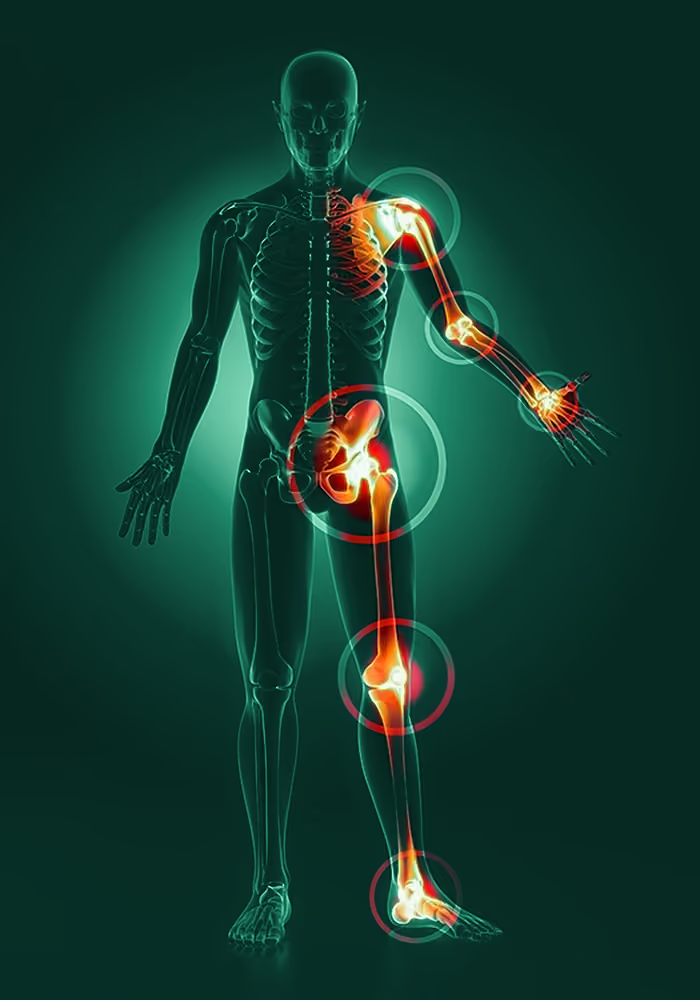
Avascular necrosis (AVN) of the hip, also called osteonecrosis of the femoral head (ONFH), happens when the blood flow to the ball of the hip joint is reduced. Without blood, the bone cells die. Over months, the weakened bone under the cartilage can crack and collapse, and the hip joint becomes painful and arthritic. AVN often affects adults between 20 and 50, and in many people it affects both hips. Finding it early, and knowing its stage, is the key to choosing the right treatment.
What is avascular necrosis (AVN)?
Bone is living tissue that needs a constant blood supply. In AVN, small blood vessels supplying an area of bone are blocked, damaged or squeezed. The affected bone dies (necrosis). The body tries to repair it, but in larger areas the repair cannot keep up, and the dead bone becomes weak.
AVN of the femoral head (hip)
The femoral head is the "ball" of the hip joint. It has a limited blood supply, which is why it is the most common site of AVN. When the dead area is small and the bone has not collapsed, the hip can sometimes be preserved. When the area is large or the surface has collapsed, the joint usually wears out.
Other sites
AVN can also affect the knee (spontaneous osteonecrosis of the knee and osteonecrosis of the femoral condyle), the shoulder (head of the humerus), the ankle (talus) and small bones of the wrist (scaphoid after a fracture, and the lunate in Kienböck disease). This page focuses on the hip; the same principles of staging and treatment apply to other joints.
Causes and risk factors
Doctors divide AVN into traumatic and non-traumatic types.
- Injury: a hip fracture or dislocation can tear the blood vessels to the femoral head.
- Steroid medicines (corticosteroids): high doses or long courses of steroid tablets or injections are one of the most common causes of non-traumatic AVN.
- Alcohol: regular heavy drinking increases the risk.
- Sickle cell disease and other blood disorders: sickled red cells can block small vessels.
- Other conditions: lupus, HIV, kidney transplant, Gaucher disease, radiation treatment, decompression sickness ("the bends") and some cancer treatments.
- No clear cause (idiopathic): in some people, no cause is found.
AVN after COVID-19 steroid treatment
During the COVID-19 pandemic many people in India received high-dose steroids, sometimes together with treatment for mucormycosis. Doctors in India reported cases of AVN of the hip appearing months after this treatment. If you had steroids for COVID-19 and now have groin or hip pain, tell your doctor; an MRI can detect AVN early, when there are more treatment options.
Symptoms
In the earliest stage, AVN may cause no symptoms and may be found by chance on an MRI. As it progresses, symptoms usually include:
- pain in the groin, sometimes felt in the buttock, thigh or knee
- pain when walking or standing, which eases with rest at first
- a limp
- stiffness and reduced movement, especially turning the leg inwards
- later, pain at rest and at night
Because AVN often affects both hips, the other hip is usually scanned too, even if it does not hurt yet.
Stages of avascular necrosis
Doctors use staging systems such as Ficat–Arlet and the ARCO classification (2019) to describe how far AVN has progressed. The stage, together with the size and position of the dead area, guides treatment.
| Stage | What the scans show | What it means | Usual options |
|---|---|---|---|
| I | X-ray normal; MRI shows the dead area | Early AVN, no collapse | Protect the hip, treat risk factors, physiotherapy; core decompression may be considered |
| II | X-ray shows changes (sclerosis or cysts); no collapse | Established AVN, joint shape preserved | Core decompression with or without bone graft; osteotomy in selected cases |
| III | "Crescent sign" or collapse of the bone under the cartilage | The surface of the ball is starting to collapse | Hip-preserving surgery only in selected small lesions; hip replacement often needed |
| IV | Collapse with arthritis of the hip joint | The joint is worn | Total hip replacement |
The size of the dead area (for example, less or more than 30% of the femoral head) also matters. Small lesions are less likely to collapse.
How AVN is diagnosed
- History and examination: your doctor asks about pain, steroid use, alcohol, injuries and other conditions, and checks hip movement.
- MRI: the most sensitive test; it detects AVN before it shows on X-ray and helps measure the size of the dead area. Both hips are usually scanned.
- X-rays: standing pelvis and hip X-rays show later changes such as collapse and arthritis.
- CT scan: sometimes used to look for small collapses before surgery.
- Blood tests: to look for causes such as sickle cell disease, lipid problems or clotting disorders, when relevant.
Send your MRI report and, if possible, the images. Our doctor can tell you the stage and the options before you travel.
Treatment without surgery in early stages
For small, early lesions without collapse, treatment aims to reduce pain, protect the bone and remove the cause.
- Remove or reduce risk factors: your doctors may review steroid doses (never stop steroids suddenly without medical advice), and stopping alcohol is strongly advised.
- Protected weight-bearing: using crutches or a walker for a period can reduce load on the hip. Evidence that this alone stops progression is limited, but it can ease pain.
- Physiotherapy: gentle range-of-motion exercises, strengthening of the hip and core muscles, and walking training keep the hip moving and the muscles strong.
- Pain medicines: short courses of anti-inflammatory medicines, used with care.
- Other medicines: bisphosphonates, blood thinners and lipid-lowering medicines have been studied. Results are mixed, and they are not standard treatment for everyone. Your doctor will explain the evidence for your situation.
Exercises for avascular necrosis of the hip
Exercises are chosen by your physiotherapist and depend on your stage and pain. They often include gentle hip range-of-motion exercises, buttock (gluteal) and thigh strengthening done lying down or seated, core exercises, stationary cycling with low resistance and exercise in water. High-impact activities such as running and jumping are usually avoided. See physiotherapy and rehabilitation.
Surgery to save the hip
When AVN is found before the bone collapses, surgery may help preserve the hip.
- Core decompression: the surgeon drills one or more small channels into the dead area of the femoral head. This lowers pressure inside the bone and may encourage new blood vessels to grow. It is most useful in stages I and II.
- Bone grafting: bone graft (sometimes with its own blood supply, a vascularised fibular graft) may be packed into the channel to support the femoral head.
- Osteotomy: the bone is cut and rotated so that a healthy part of the femoral head carries the body's weight. Used in selected younger patients.
Which of these procedures are performed at StemRx, and by which surgeon, is [to confirm with StemRx]. If a procedure is not done here, we will explain why and where we would refer you.
Stage 2 AVN treatment
In stage II, the femoral head still has its normal shape. Options usually include core decompression, with or without bone graft, plus protected weight-bearing and physiotherapy. The aim is to delay or prevent collapse; this does not always succeed, and some people later need a hip replacement.
Stage 3 AVN treatment
In stage III, the surface has begun to collapse. Hip-preserving surgery is less likely to work, except for some small lesions in younger people. Many people with stage III AVN and significant pain are offered total hip replacement.
Hip replacement
In total hip replacement, the damaged ball and socket are replaced with artificial parts. It is a common and reliable operation for stage III–IV AVN with collapse and arthritis. Most people walk with support within a day or two and return to everyday activities over several weeks to months, with physiotherapy. Your surgeon will explain the risks, including infection, blood clots, dislocation and wear of the implant over time. Whether hip replacement is performed at StemRx is [to confirm with StemRx].
What about stem cell or "cell" injections for AVN?
You may see advertisements for stem cell, "bone marrow concentrate" or "cell-based" treatment for AVN. Some studies have combined core decompression with cells taken from the patient's own bone marrow, but these are still being studied and results vary. In India, stem cell therapy is approved as standard treatment only for specific blood disorders. For AVN it is experimental and may be given only inside approved, registered clinical trials. The National Medical Commission said in September 2026 that mesenchymal stem cell transplantation is not recommended for any disease. StemRx does not offer stem cell or cell-based injections for AVN. If a clinic offers them for a fee, ask for the trial's CTRI registration number and ethics approval.
Living with AVN: how long can you live with it?
Avascular necrosis is not life-threatening, and it does not shorten life by itself. The question is how long the hip joint will last. Small, early lesions may stay stable for years; larger lesions often collapse within a few years. Regular review, protecting the hip, staying active within your limits and treating the cause all help. If the hip does wear out, a hip replacement usually relieves pain and restores function.
AVN care at StemRx
- Send your reports: MRI and X-ray reports, and images if possible, plus a list of medicines (especially steroids).
- Doctor review: our orthopaedic team [confirm: Dr S. H. Thorat, MS Orthopaedics] reviews your scans and tells you the likely stage and options.
- Assessment in Navi Mumbai: examination, repeat imaging if needed, blood tests and a physiotherapy assessment.
- Your plan: non-surgical care, hip-preserving surgery or hip replacement, or referral, with a written estimate.
- Follow-up: a home exercise plan and follow-up by phone or video call [confirm].
Patients from abroad
Many people with AVN travel from the Gulf and Africa. For an assessment and non-surgical plan, a short stay may be enough; after hip surgery, people usually stay longer for wound checks and early physiotherapy before flying [confirm typical stay]. See international patients.
Cost
The cost depends on whether you need non-surgical care, hip-preserving surgery or hip replacement, the implant, the room type and the length of stay. After a doctor reviews your reports we send a written estimate. See how estimates work.
Risks and limitations
- AVN can progress even with treatment. Early-stage treatment aims to delay or prevent collapse, but no treatment can promise this.
- Every operation has risks, which your surgeon explains before you decide.
- Results differ from person to person.
Frequently asked questions
What is AVN?
AVN (avascular necrosis, or osteonecrosis) is death of bone tissue caused by a poor blood supply. It most often affects the head of the thigh bone in the hip. Over time, the weakened bone can collapse and the hip becomes arthritic.
Can AVN be treated without surgery?
In early stages, before the bone has collapsed, AVN can sometimes be managed without surgery: reducing risk factors, protecting the hip, physiotherapy and pain relief. Many people with early AVN are also offered core decompression. Once the bone collapses, surgery is usually needed.
What is the first sign of AVN?
Often a dull ache in the groin or buttock that is worse when walking or standing. In the very early stage there may be no symptoms, and AVN is found on an MRI done for another reason.
Can AVN heal on its own?
Very small lesions sometimes stay stable or improve, but most larger lesions do not heal by themselves. Regular follow-up with MRI or X-ray is important.
Which stage of AVN needs hip replacement?
Hip replacement is usually considered when the femoral head has collapsed and the joint is arthritic (stages III–IV) and pain affects daily life. Your surgeon decides together with you.
Can AVN happen after COVID?
Yes. AVN has been reported months after high-dose steroid treatment for COVID-19. If you had steroids and now have hip or groin pain, ask your doctor about an MRI.
How long can you live with avascular necrosis?
AVN is not life-threatening and does not shorten life. The issue is the joint: depending on the stage, a hip may stay usable for years, or may need replacement.
Is stem cell therapy for AVN approved in India?
No. StemRx does not offer it. In India, stem cell therapy for AVN is experimental and allowed only inside approved clinical trials. StemRx does not offer it.
References
AAOS OrthoInfo. Osteonecrosis of the hip. · Yoon BH et al. The 2019 revised version of Association Research Circulation Osseous staging system of osteonecrosis of the femoral head. J Arthroplasty 2020;35(4):933-940. · Mont MA et al. Nontraumatic osteonecrosis of the femoral head: where do we stand today? J Bone Joint Surg Am 2020;102(12):1084-1099. · Agarwala SR et al. Avascular necrosis as a part of 'long COVID-19'. BMJ Case Rep 2021;14:e242101. · National Medical Commission advisory, 5 Sep 2026. · ICMR–DBT National Guidelines for Stem Cell Research (2017).