

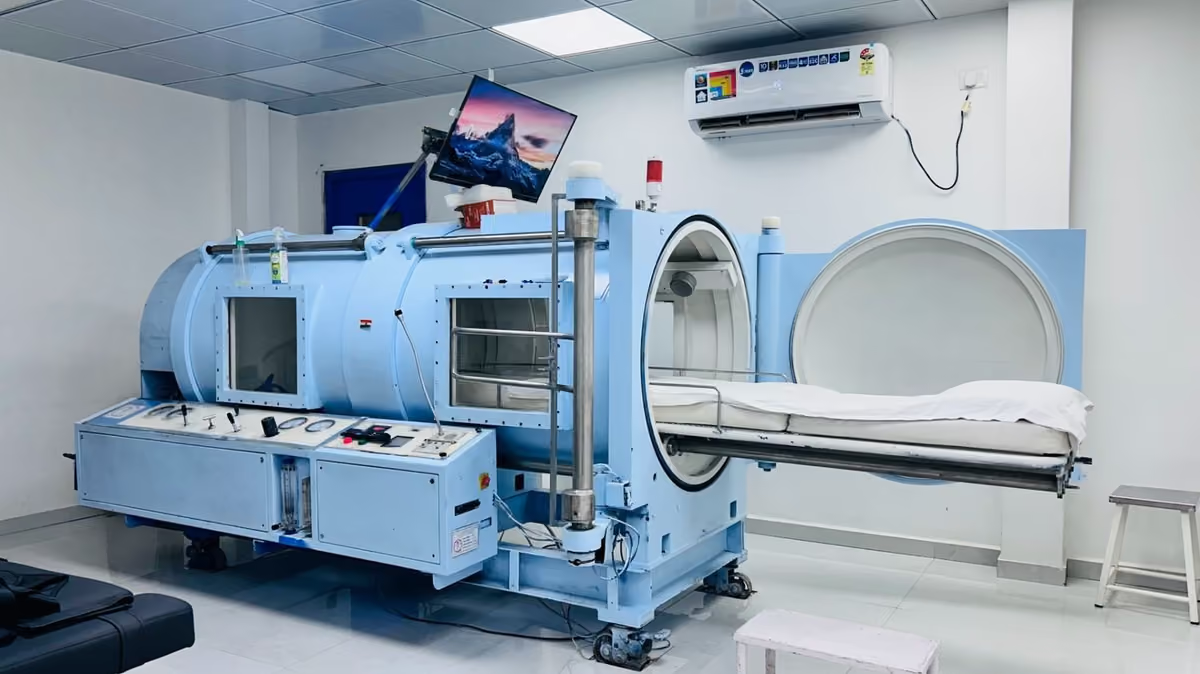
What is hyperbaric oxygen therapy (HBOT)?
In hyperbaric oxygen therapy (HBOT) you breathe pure oxygen inside a pressurised chamber. The higher pressure lets the blood carry more oxygen to the tissues. HBOT is a recognised treatment for a specific list of conditions, set by bodies such as the Undersea and Hyperbaric Medical Society (UHMS). StemRx has a hospital HBOT chamber on site [confirm chamber type, capacity and supervising staff].
What to expect
You lie or sit in the chamber while the pressure is slowly increased. You may feel fullness in your ears, as in an aeroplane. A session usually lasts 90–120 minutes, and a course for a wound may need 20–40 sessions over several weeks. Trained staff watch you throughout.
Services [to confirm with StemRx]
- Diabetic foot ulcers that have not closed with standard care (as an add-on, for selected patients)
- Radiation injury to tissues
- Carbon monoxide poisoning
- Decompression sickness and gas embolism
- Some severe infections and crush injuries
Good to know
HBOT is not an evidence-based treatment for autism, cerebral palsy, dementia, Parkinson's disease or anti-ageing. NICE advises against using HBOT for autism. StemRx uses HBOT only for recognised medical uses [confirm].
Safety and side effects
- Ear and sinus pain (barotrauma)
- Temporary short-sightedness
- Rarely, oxygen-related seizures
- Not suitable for some lung conditions; a doctor checks you first
- Claustrophobia
Frequently asked questions
Does HBOT help autism?
Good-quality studies have not shown benefit for the core features of autism, and NICE advises against it. StemRx does not use HBOT to treat autism [confirm].
How many sessions are needed?
For a slow-to-close diabetic foot ulcer, often 20–40 sessions. Your doctor decides after an assessment.
Can I fly after HBOT?
Ask your doctor; usually you should wait at least 24 hours after the last session.
References
UHMS. Hyperbaric Oxygen Therapy Indications, 15th ed. (2023). · IWGDF guidelines on wound healing interventions (2023). · NICE CG170.